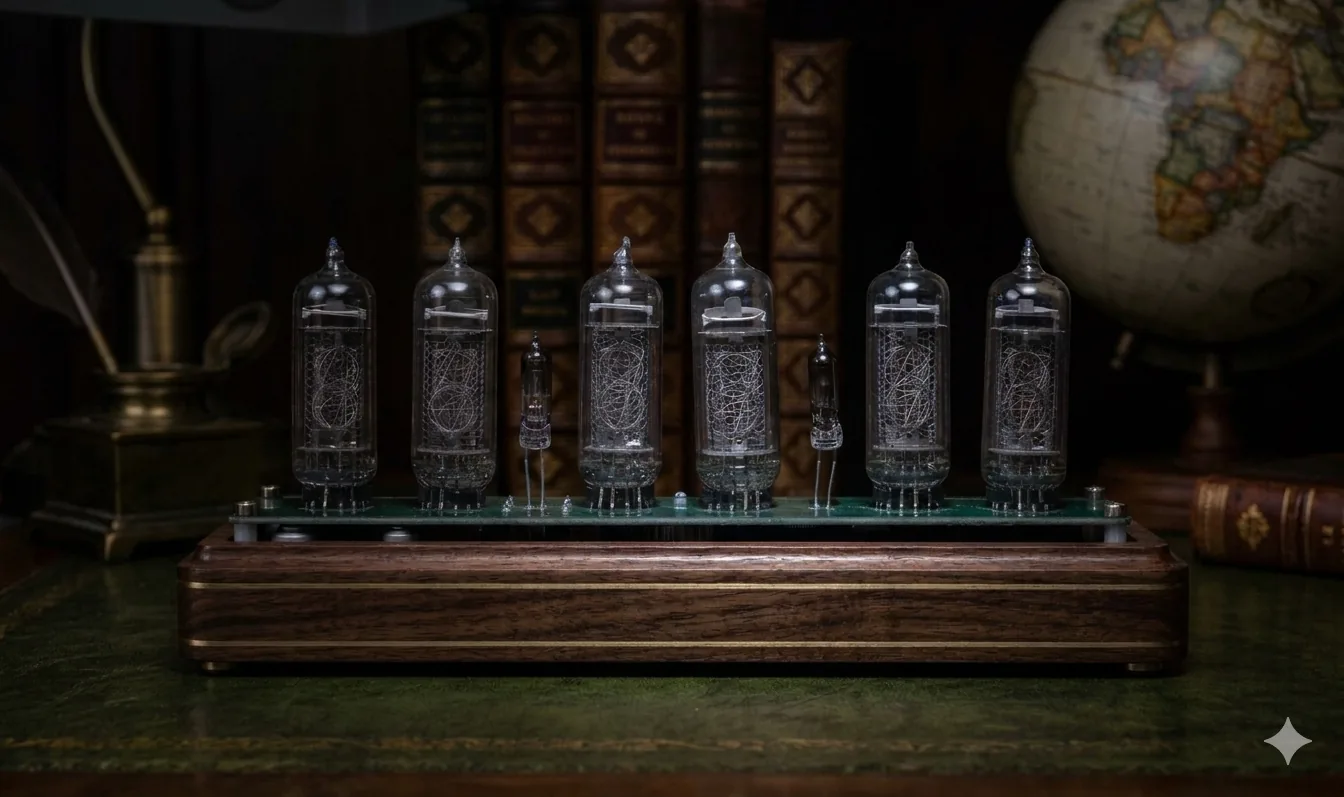
What is a Nixie tube?
A glass tube filled with neon gas, with ten wire digits stacked inside that glow orange when switched on.
Each cathode is bent into a digit from 0 to 9, behind a fine metal mesh. Put a voltage on one and the gas around it lights up, so the number appears written in light.
Nixie tubes showed up in the mid-1950s on voltmeters, frequency counters and the first electronic calculators. In the 1970s, cheaper LED and vacuum fluorescent displays took over.
Today they live on as desk clocks built by vintage electronics fans. Each digit sits on its own layer in the glass, so lit numbers look slightly nearer or farther away. That depth is a big part of the charm.
How do I use this Nixie clock?
The tubes warm up, then show the exact time, corrected against our server. The date and your time zone appear below.
- 12h or 24h: follows your device setting by default. Your choice is saved in this browser.
- Seconds: switches off the last two tubes for a calmer clock.
- Full screen: the button, a tap on the tubes, or F. The screen stays on where the browser allows it.
The tube photo is an illustration. The lit digits are drawn on top of it by the page, second by second.
Frequently asked questions
Is the time accurate?
It is the same time as the site’s main clock. When the page opens, it compares your device clock with our server and corrects the difference, to within about one second.
Can I leave it running as a desk clock?
Yes. Press F or the full screen button. In full screen the page asks the device to keep the screen on, in browsers that allow it. On a phone or tablet, keep it plugged in.
Why do the digits flicker now and then?
On purpose: it mimics the slight unsteadiness of a real tube’s glow. If your system is set to reduce motion, the flicker and the warm-up are turned off.
Are Nixie tubes still made?
Mass production ended when LED displays replaced them in the 1970s. Nixie clocks today mostly use old stock tubes, and a handful of small workshops have started making new ones.